
Nebula
Cat's Eye Nebula
Planetary nebula · C6 · NGC 6543
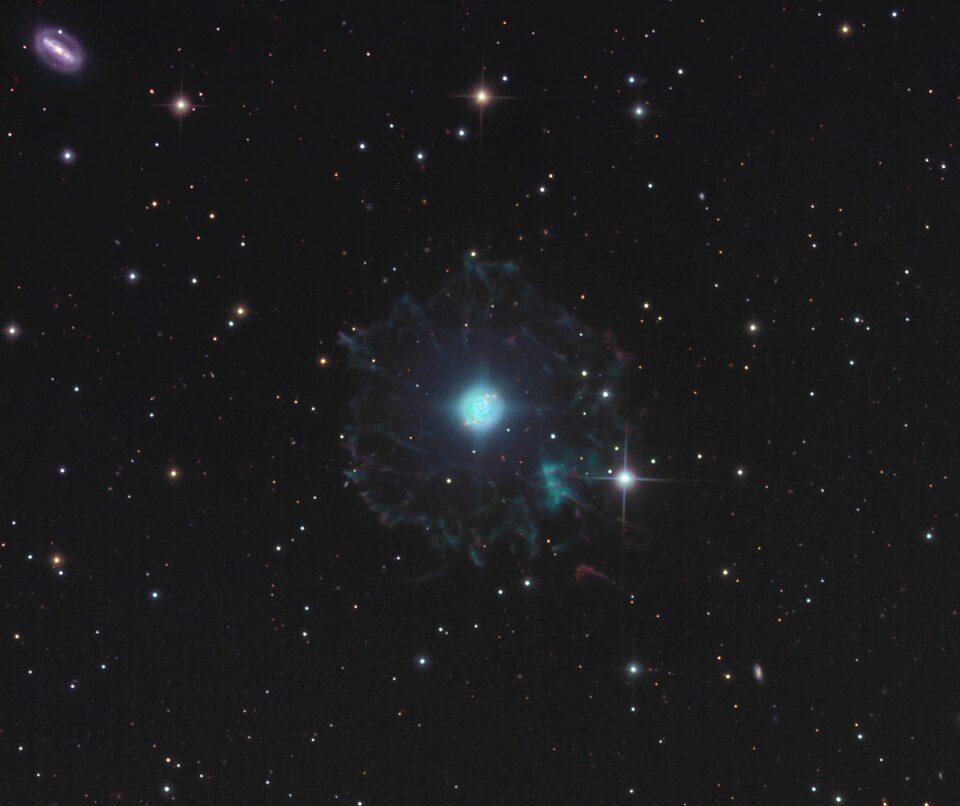
Planetary nebula in Draco
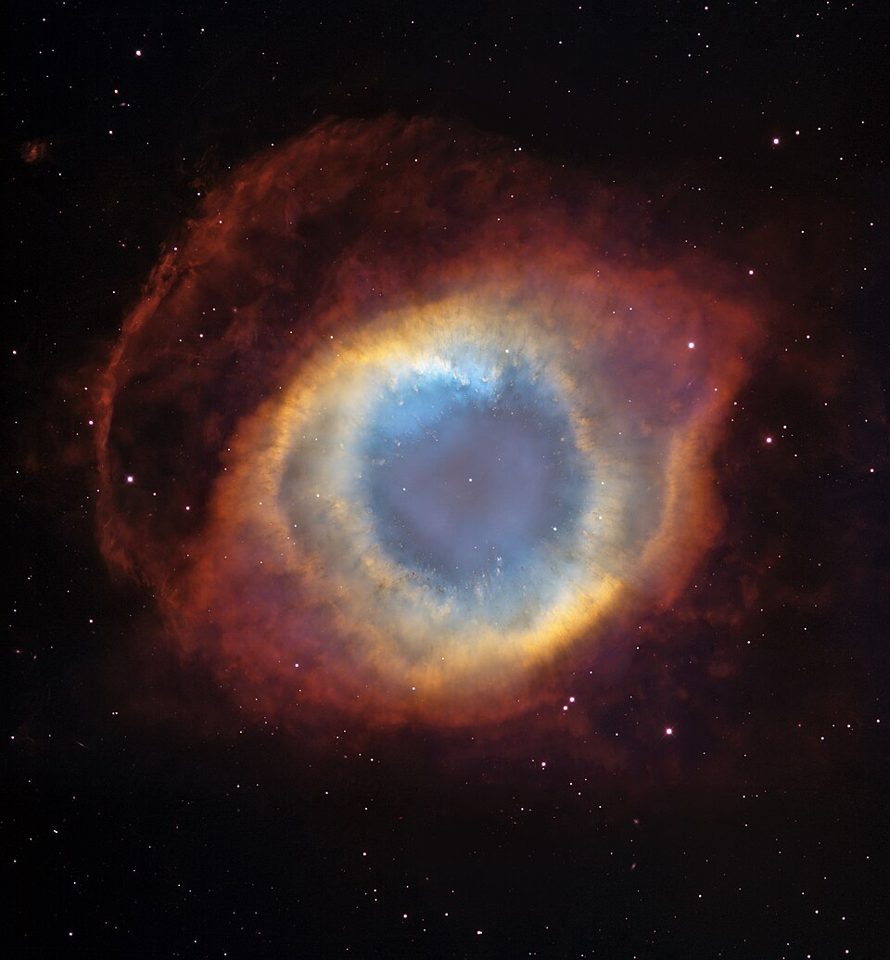
Photo: Credit Line and Copyright Adam Block/Mount Lemmon SkyCenter/University of Arizona · CC BY-SA 3.0 us · Wikimedia Commons
The Cat's Eye Nebula is a planetary nebula in the northern constellation of Draco, discovered by William Herschel on February 15, 1786. It was the first planetary nebula whose spectrum was investigated by the English amateur astronomer William Huggins, demonstrating that planetary nebulae were gaseous and not stellar in nature. Structurally, the object has had high-resolution images by the Hubble Space Telescope revealing knots, jets, bubbles and complex arcs, being illuminated by the central hot planetary nebula nucleus (PNN). It is a well-studied object that has been observed from radio to X-ray wavelengths. At the centre of the Cat's Eye Nebula is a dying Wolf–Rayet star, the sort of which can be seen in the Webb Telescope's image of WR 124. The Cat's Eye Nebula's central star shines at magnitude +11.4. Hubble Space Telescope images show a sort of dart board pattern of concentric rings emanating outwards from the centre.
Description from Wikipedia (CC BY-SA 4.0).
In your sky
Share your location to see where this is in your sky right now.
Key facts
Distance
~3,000 light-years
Apparent mag.
+9
Apparent size
0.9′
Best seen with
Binoculars
Catalogue
C6 · NGC 6543
Did you know
- Listed as Caldwell 6 in the Caldwell catalogue, also known as NGC 6543.
- Found in the constellation Draco.
- Within reach of ordinary binoculars under dark skies.