
Galaxy
Messier 106
Spiral galaxy · M106 · NGC 4258
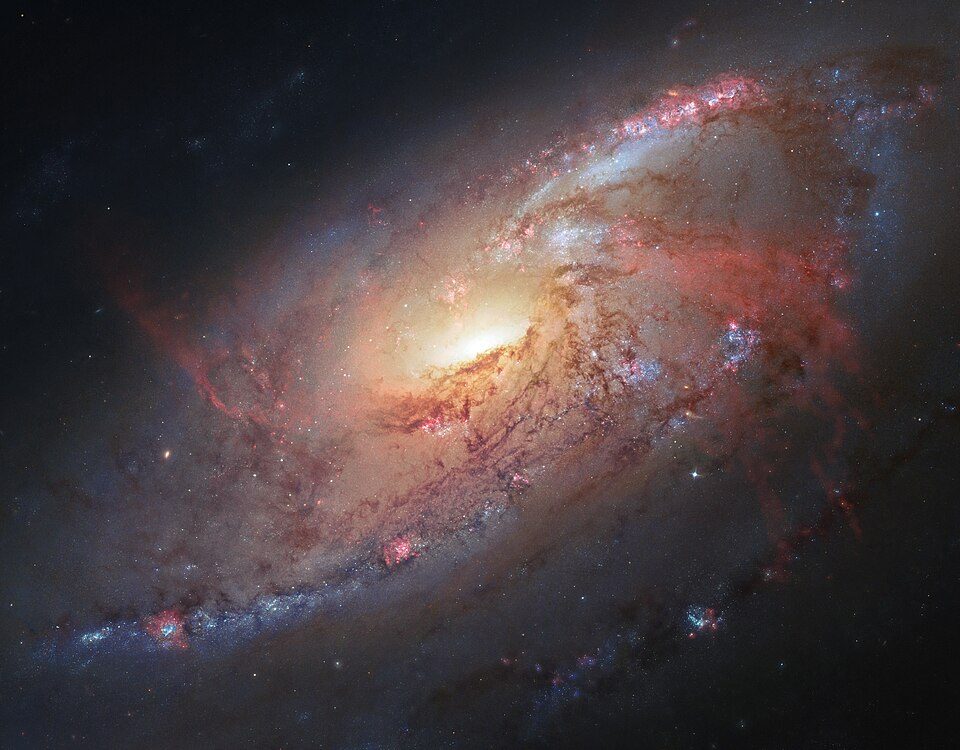
Spiral galaxy in Canes Venatici
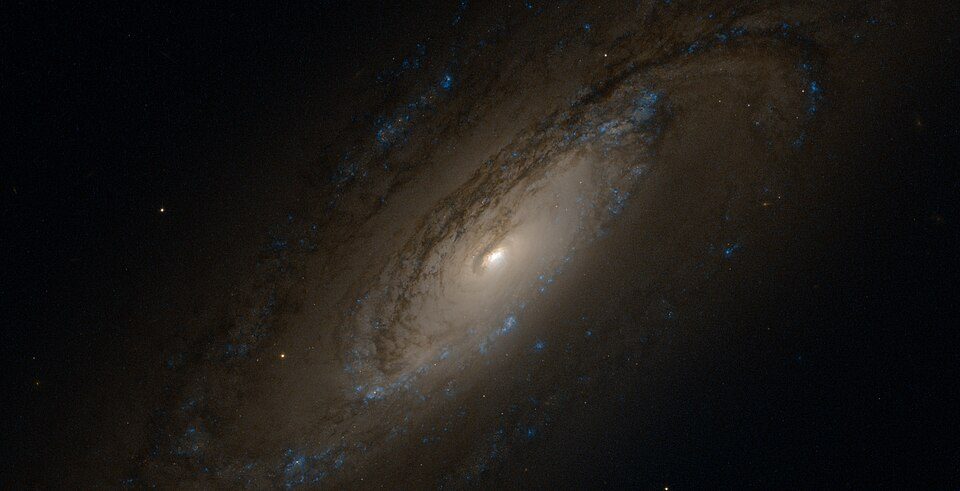
Photo: NASA, ESA, the Hubble Heritage Team (STScI/AURA), and R. Gendler (for the Hubble Heritage · Public domain · Wikimedia Commons
Messier 106 is an intermediate spiral galaxy in the constellation Canes Venatici. It was discovered by Pierre Méchain in 1781. M106 is at a distance of about 22 to 25 million light-years away from Earth. M106 contains an active nucleus classified as a Type 2 Seyfert, and the presence of a central supermassive black hole has been demonstrated from radio-wavelength observations of the rotation of a disk of molecular gas orbiting within the inner light-year around the black hole. NGC 4217 is a possible companion galaxy of Messier 106. Besides the two visible arms, it has two "anomalous arms" detectable using an X-ray telescope.
Description from Wikipedia (CC BY-SA 4.0).
In your sky
Share your location to see where this is in your sky right now.
Key facts
Distance
~22.2–25.2 million light-years
Apparent mag.
+8.4
Apparent size
18.6′ × 7.2′
Best seen with
Binoculars
Catalogue
M106 · NGC 4258
Did you know
- Listed as Messier 106 in the Messier catalogue, also known as NGC 4258.
- Found in the constellation Canes Venatici.
- Within reach of ordinary binoculars under dark skies.